

Pacific Rubber & Packing Launches VeriClean Seals™ | Elastomer Seals With Documented Particulate Levels for AI Cooling
Vericlean
Vericlean
Vericlean
Particulate shed by seals settles on cold plates before a rack reaches steady state. VeriClean Seals™ closes the cleanliness gap no one in liquid cooling owns.
Everyone building AI data centers knows particulate contamination is in their loops, but no one owns the contribution of seals to it...”
SAN CARLOS, CA, UNITED STATES, August 11, 2026 /EINPresswire.com/ -- Pacific Rubber & Packing, Inc. (PRP), a precision sealing supplier to the semiconductor industry since 1979, today announced the launch of VeriClean Seals™, the first elastomeric seals for liquid-cooled data centers with documented, verified surface particulate cleanliness.— Bill Sharratt, President
Processed in PRP's ISO Class 7 cleanroom using a patent-pending particulate-reduction process, VeriClean Seals™ reduce surface particle counts and particle volume by 60–90% across tested elastomer families, verified by 30 individual particle extraction and count tests across size buckets from ≥1.3 µm, before they enter a cooling loop. The line targets the direct-to-chip loops now standard in rack-scale accelerator systems, where coolant passes within millimeters of the die and the cold plate is the last thermal interface protecting a multimillion-dollar compute node.
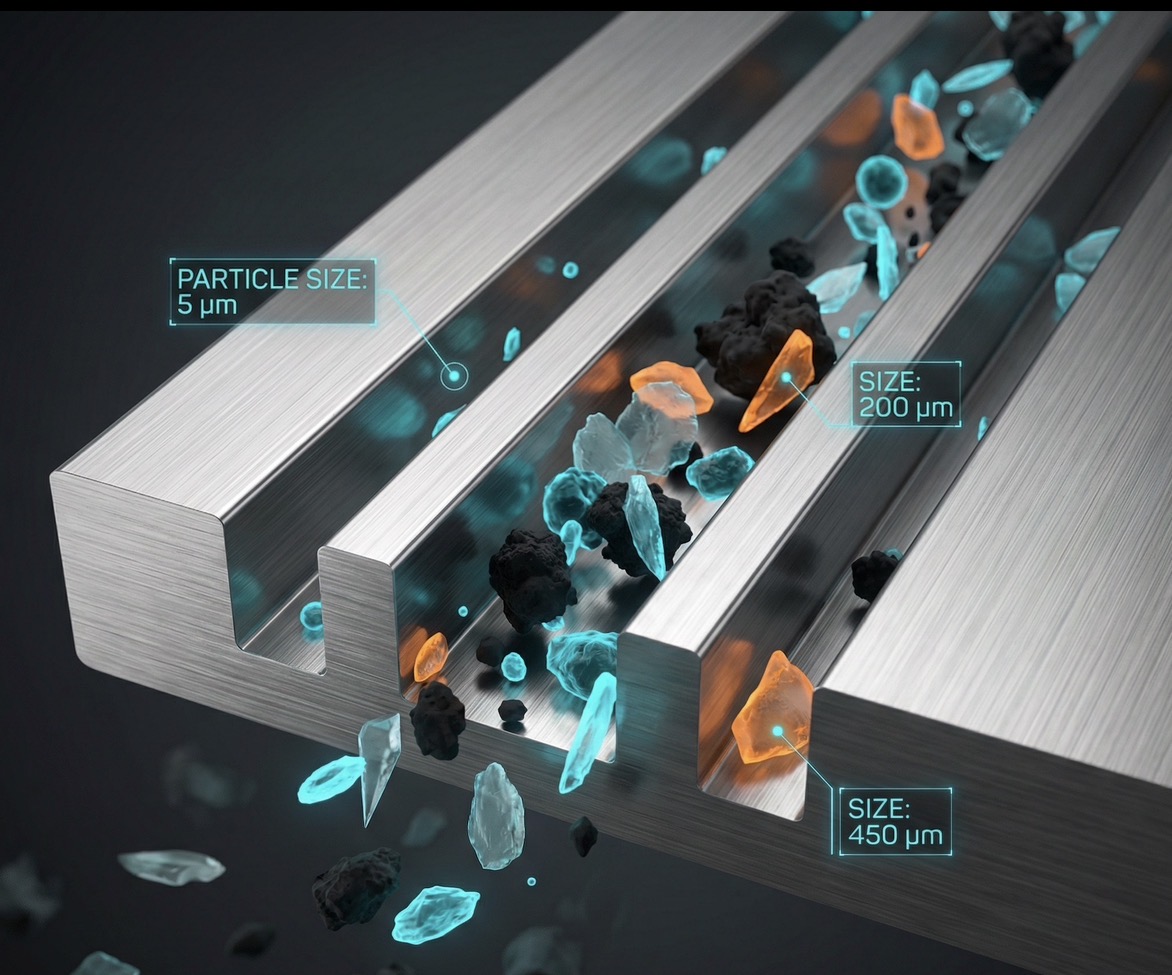
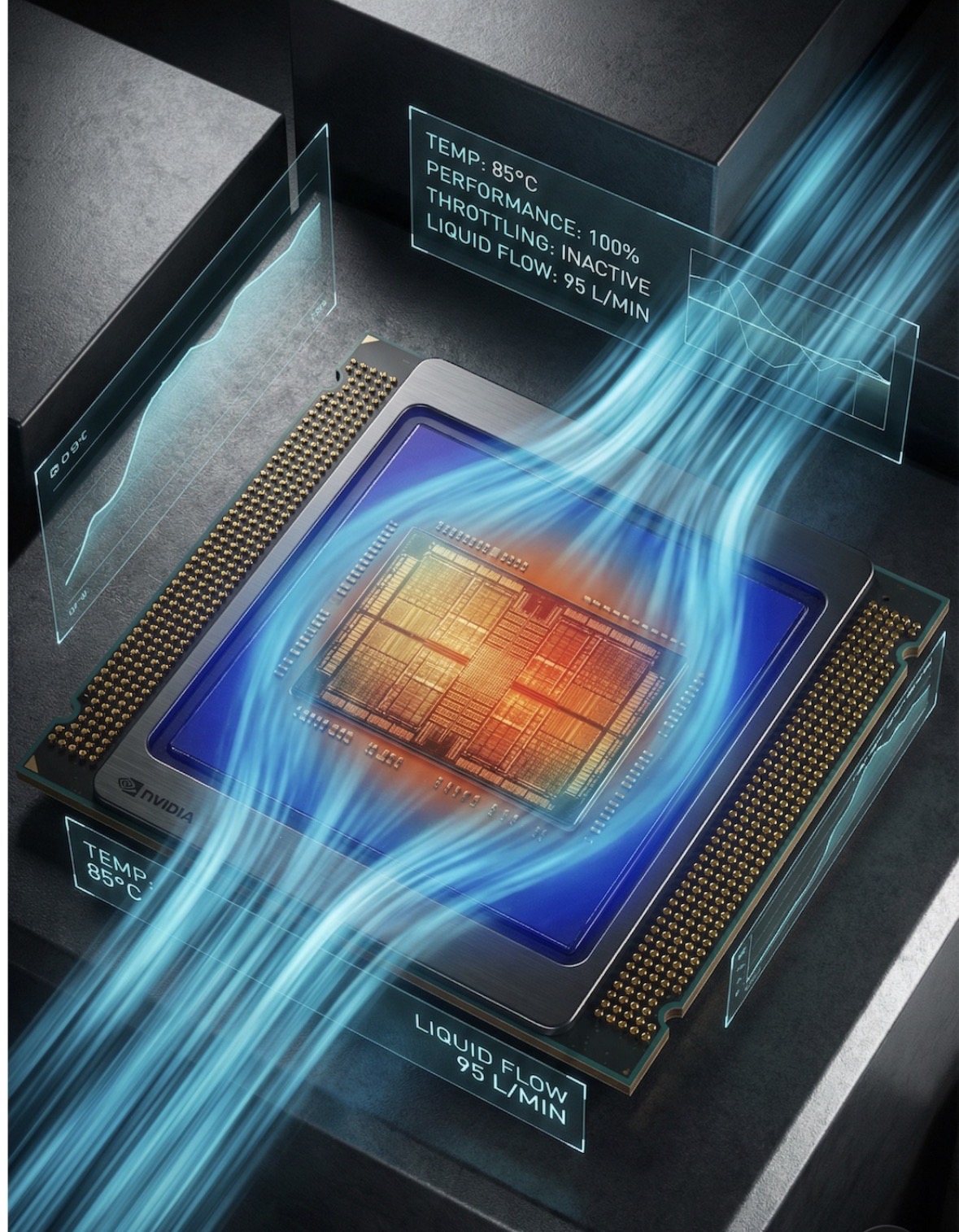
Direct-to-chip liquid cooling has become the default thermal architecture for AI infrastructure, and every loop depends on hundreds of elastomer seals, gaskets, and O-rings. As manufactured, those components shed microscopic particles into the coolant. PRP's extraction testing routinely finds more than 130,000 particles per square centimeter at ≥1.3 µm on as-received commercial seals, with more than twentyfold variation between seals pulled from the same bag, and price and visual grade correlate only weakly with what is actually on the surface. The governing inspection standard, ISO 3601-3, calls for visual examination at ×2 magnification, which is structurally blind at that particle size. Modern cold plates route coolant through microchannels measured in fractions of a millimeter, the first place shed particulate settles, and the hardest place to clear once a rack is in production. Industry research shows that even a thin layer of fouling can raise GPU temperatures 5–8°C, enough to trigger thermal throttling on H100-class chips, extend AI training runs, and increase energy consumption.
Two assumptions keep this problem invisible. The first is that the loop flushes itself clean. It does not. Loop filtration is sized to catch debris, not sub-micron particulate, and what passes through settles wherever the coolant slows down, precisely the boundary layer inside a cold plate microchannel, where velocity at the wall approaches zero. Particulate does not circulate until the system is drained. It deposits, builds, and stays.
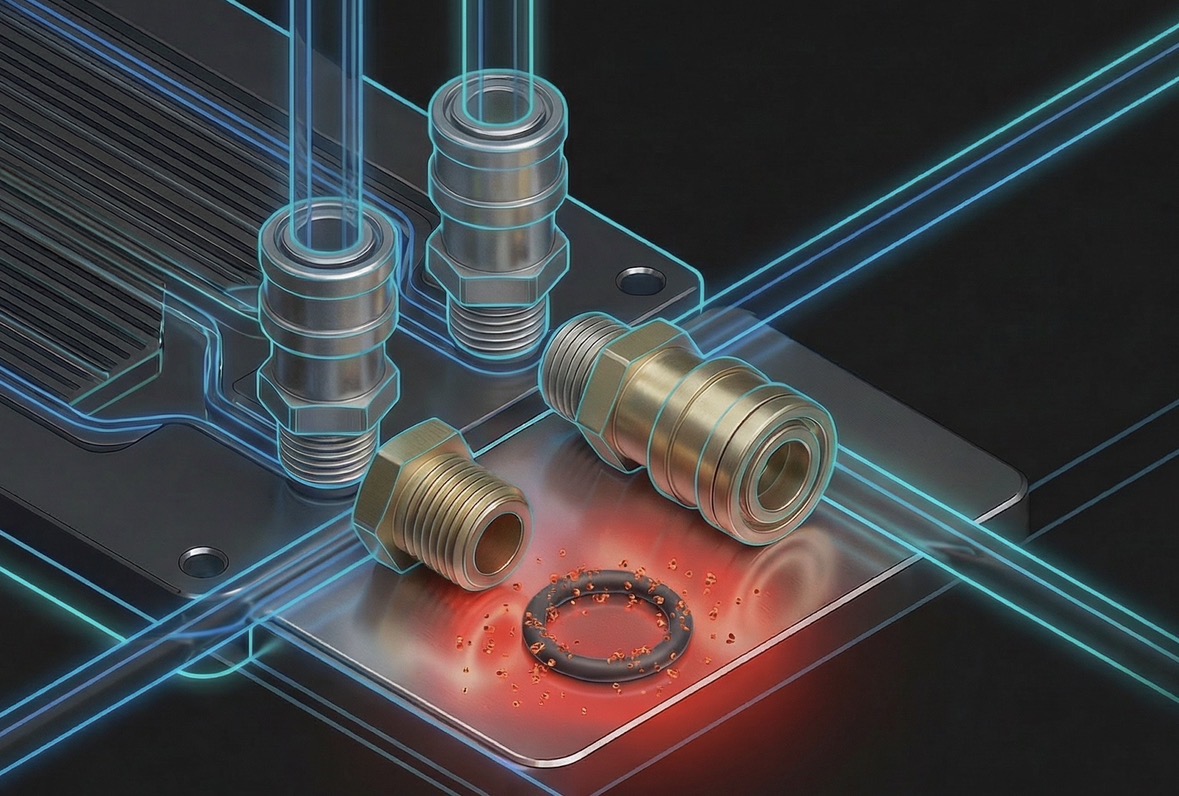
The second assumption is that there is not much elastomer in the loop. Counted honestly, the wetted surface is not the visible sliver of an O-ring face. It is the full coolant-contact area of every seal, gasket, and quick-disconnect in the system, multiplied across hundreds of joints per rack. PRP calls the mechanism Cyclic Contamination Displacement™: under pressurization and thermal and mechanical cycling, the effective wetted area of an O-ring expands three- to eightfold beyond its static footprint, and contamination release is cumulative and ongoing rather than a one-time installation event. Across a single row, the elastomer surface bathed in coolant is measured in square feet, and every square inch sheds into the same fluid that ends up in the microchannels.
ITIC's Hourly Cost of Downtime Survey puts the cost of a single hour of downtime above $300,000 for more than 90% of mid-size and large enterprises, and Uptime Institute attributes roughly 13% of impactful data center outages to cooling failures. The exposure is growing. In its Sigma Insights 07/2026 report on insuring AI data centers, Swiss Re notes that a single AI facility can cost up to $20 billion to build; that escaped liquid damage from new cooling systems accounts for roughly 10% of data center loss costs; and that data center insurance premiums are projected to grow from $10.6 billion to $24.2 billion by 2030.
Yet no one in the supply chain owns seal cleanliness. Mechanical vendors specify materials. Coolant suppliers specify chemistry. Component manufacturers publish no particulate cleanliness specifications, and coolant testing labs have no thresholds to test against. Alongside the VeriClean Seals™ launch, PRP is publishing its baseline contamination data for as-received commercial seals and calling for a component-level surface cleanliness specification that operators, OEMs, and insurers can hold every wetted elastomer component in a liquid cooling loop to. PRP is inviting accelerator platform vendors, cooling OEMs, and hyperscale operators to work toward a common cleanliness specification for wetted elastomers, the same way the semiconductor industry standardized cleanliness for fab consumables.
"Everyone building AI data centers knows particulate contamination is in their loops, but no one owns the contribution of seals to it," said Bill Sharratt, president of Pacific Rubber & Packing. "We've spent decades supplying seals to semiconductor fabs, where cleanliness isn't optional, it's specified, measured, and certified. VeriClean Seals™ brings that discipline to liquid cooling. The two things people get wrong are that the loop flushes itself and that there is barely any rubber in it. Neither is true, and the cold plate is where you find that out. A seal is one of the cheapest parts in the loop, and it sits directly upstream of the most expensive silicon in the building. When that's the asymmetry, 'clean enough' isn't a spec. Documented cleanliness is."
VeriClean Seals™ are now available to data center operators, cooling system OEMs, cold plate and CDU manufacturers, and colocation providers. Each order ships with cleanliness verification documentation. VeriClean processing does not alter compound, durometer, dimensions, or chemical compatibility, so parts already qualified against an existing BOM specification require no requalification. Qualification samples and lot-level cleanliness data are available on request to platform vendors and operators evaluating new rack designs.
Read or download The Contamination Variable Your TCS Loop Spec Doesn't Address
More information, including PRP's baseline contamination data, the Get Characterized assessment program, and the whitepaper "The Hidden Costs of Contamination in Liquid-Cooled Systems," is available at www.vericlean.one.
About Pacific Rubber & Packing, Inc.
Founded in 1979 and headquartered in San Carlos, California, Pacific Rubber & Packing, Inc. engineers and supplies precision elastomer seals, O-rings, and gaskets for the semiconductor, data center, medical device, biopharma, aerospace, and energy industries. PRP operates an ISO Class 7 cleanroom with in-house precision cleaning and certified cleanliness processing. Learn more at pacificrubber.com and vericlean.one.
Michelle Murray-Smith
PRP
+1 650-595-5888
email us here
Visit us on social media:
LinkedIn
The Mission Critical Contaminant No One Owns
Legal Disclaimer:
EIN Presswire provides this news content "as is" without warranty of any kind. We do not accept any responsibility or liability for the accuracy, content, images, videos, licenses, completeness, legality, or reliability of the information contained in this article. If you have any complaints or copyright issues related to this article, kindly contact the author above.
